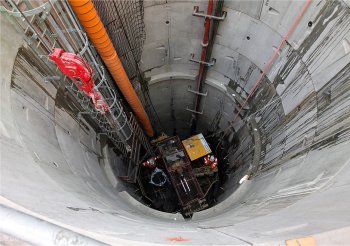
Following several incidents when lifting reinforcement cages, the FPS and BAR (British Association of Reinforcement) have collaborated to produce a guidance note. This outlines current best practice in relation to the design and lifting of pre-fabricated reinforcement cages and site fabricated reinforcement cages for piling and walling works.
The document covers the provision of cage design information; information required on the purchase order; delivery and lifting on site; and quality. Two safety checklists (one for piling cages and one for diaphragm wall cages) are also provided. View guidance note Pile Cage Safety Check List Diaphragm Wall Cage Safety Check List
Casting In Situ Concrete Piles and Diaphragm Wall Panels in Cold Weather in the UK
The FPS has produced a guidance note on best practice in casting in situ concrete piles and diaphragm wall panels in the ground during cold weather in the UK. View guidance note
Concrete Cube Testing
Materials laboratories generally use their own format to report concrete test results. The contractor receiving the report, however, may deal with a number of laboratories, and therefore receives reports in a number of different formats. This can be confusing and time consuming, particularly if the raw data has to be manipulated or re-entered in order to transfer it to a database.
Additionally, laboratories may be asked by clients to customise the results, which can also be time consuming and less efficient. In order to streamline and make the process more efficient, the FPS have agreed with laboratories to trial a standard format. UKAS have confirmed that this is suitable for use by Registered Laboratories.
FPS Members have prepared the Excel spreadsheet based template and have agreed to use it unamended (to ensure that laboratories are not subject to variations). The FPS would welcome feedback from laboratories and contractors. View Concrete Cube Testing Template
This document reports the results of a survey of over 200 projects carried out between July and September 2006 and highlights many shortcomings in the quality of Site Investigation Reports.
Technical considerations related to the use of debonding foam on pile reinforcement. View Guidance
Breaking Down of Piles
The adoption of a suitable pile breaking method can result in financial and program savings and, most importantly, will address and reduce potential health and safety issues. In this document, the FPS consider the different methods available. View guidance
Safety in Design
Guidance on the application of CDM 2007 to pile foundations and embedded retaining walls, and examples of hazards associated with such works and how these might be managed within the design phase of a project. View guidance document View examples of hazards
FPS Guidance: CFA Piling: Preventing ground & rig instability through over-flighting
The guidance outlines the key factors that may lead to settlement or instability of the piling rig when carrying out Continuous Flight Auger (CFA) piling as a result of over-flighting and presents best practice to mitigate these risks. View guidance
Information to assist the decision whether or not a particular bentonite will produce a satisfactory support fluid. Guidance on the preparation, use, re-use and disposal of the bentonite slurry, and also on methods of testing.
The legacy of unexploded explosive ordnance (UXO) occasionally leads to problems on construction projects in the UK. These problems have led to delays and increased costs, especially during the groundwork phases of construction. The CIRIA guide “Unexploded Ordnance (UXO) – a construction industry guide” presents industry best practice for the assessment and management of UXO risk for construction projects. This note summarises some aspects relevant to piling and ground improvement contractors.
The aim of this document is to provide a simple summary of temporary works items that are commonly associated with the various forms of ground engineering that FPS members may undertake. This is designed as an aide memoir for FPS members, main contractors, engineers and their clients and does not constitute a definitive list of temporary works that could be encountered on site. In particular this does not remove the need for individual organisations to undertake site specific assessments of temporary works requirements. Statutory legislation and the Contract will define the respective responsibilities of the parties involved to manage the design and checking of temporary works.


 Pile Cage Safety Check List
 Diaphragm Wall Cage Safety Check List